Let’s imagine that we want to digitize the following verb conjugation (Gair and Karunatillake 2013:7):
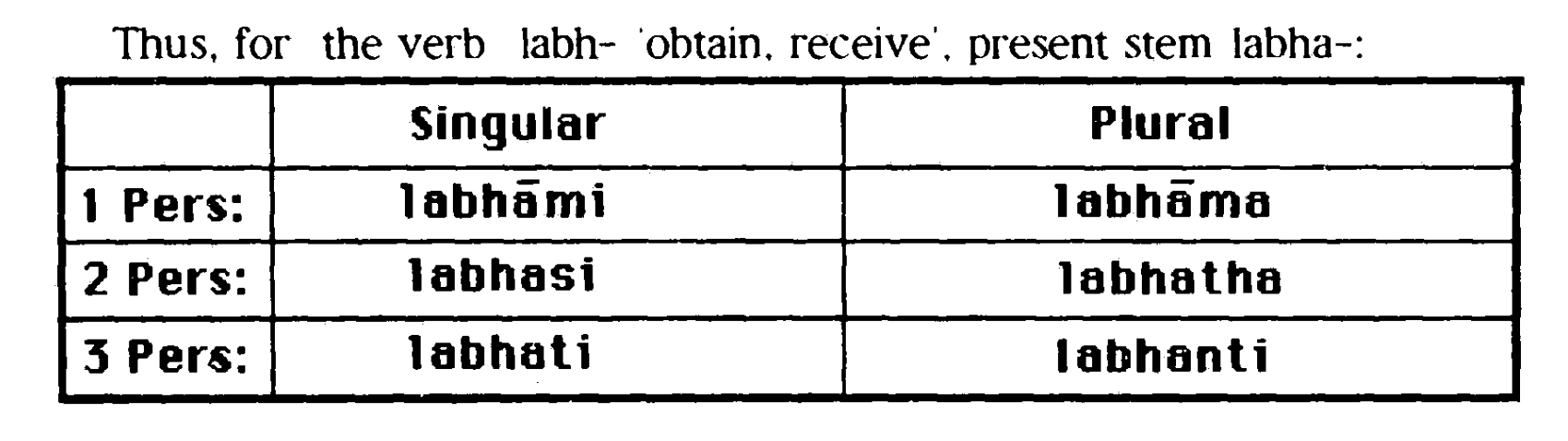
There are six verb forms here, and each varies across two dimensions: CASE and NUMBER. NUMBER has two possible values in this language, namely singular and plural. PERSON has three values, 1, 2, and 3.
The goal of the <paradigm-builder> component is to help simplify the process of recording not just the paradigmatic elements (in this example forms of the conjugation), but the grammatical values — which I call features — associated with each form.
So we don’t just want to record a table of forms of this verb, we want to generate a word list — a lexicon, essentially — where each form is associated with a `features` object which has the right values.
To try it, type PERSON in the row category, and 1 2 3 in the row values. Then, put NUMBER in the column category, and SG PL in the column values.
Then press enter.